The Evolution of Intelligent Communications:From Bit-Centric to Token-Oriented Optimization-The Cycle of the World & Me-LM
The Evolution of Intelligent Communications: From Bit-Centric to Token-Oriented Optimization
Introduction
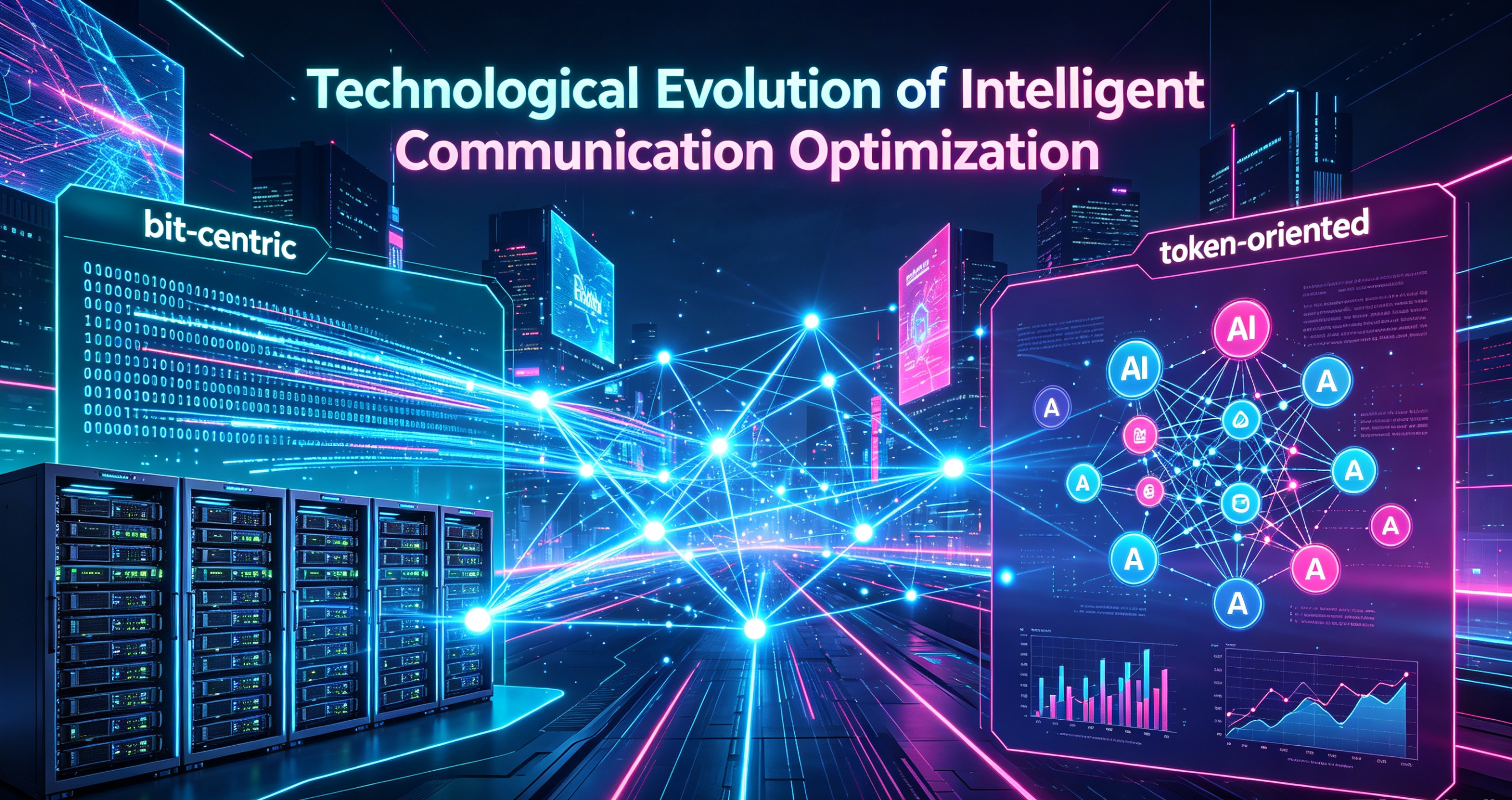
For decades, wireless communication systems have revolved around optimizing physical-layer resources: bits, power, bandwidth, and latency. The core mathematical framework—rooted in Shannon’s information theory—treats data as sequences of binary digits, and the goal is to maximize reliable bit transmission under resource constraints. Today, the rise of large language models (LLMs) and semantic-aware paradigms is rewriting this playbook. In modern intelligent communications, the fundamental unit of optimization is no longer the bit, but the token. This shift is not just a superficial change in terminology; it represents a full-circle evolution of communication, where the carrier of meaning has returned to its roots, now embodied by model-level semantic representations. This article explores how the optimization paradigm is evolving from traditional bit-centric frameworks to token-oriented, attention-driven resource allocation.
1. The Legacy: Bit-Centric Optimization in Classical Communications
Traditional communication systems operate on a clear, well-defined mathematical foundation. Every optimization problem—from channel coding to power control to bandwidth allocation—centers on physical variables:
Transmit power $P$
Bandwidth $B$
Signal-to-noise ratio (SNR)
Bit error rate (BER)
Latency $T$
These variables are plugged into classic formulas, such as the Shannon capacity formula $C = B \log_2(1 + \text{SNR})$, to define the system’s maximum achievable rate. The core idea is straightforward: maximize the number of reliable bits delivered per unit of resource.
However, this paradigm has a critical limitation: it treats all bits as equal. A bit representing noise is given the same priority as a bit carrying critical semantic information. In the era of AI-native applications—where the goal is to convey meaning, not just raw data—this bit-level equality is inefficient and wasteful.

2. The Revolution: Token-Oriented Optimization in Semantic Communications
The shift to token-oriented optimization redefines the problem entirely. In semantic communication systems powered by LLMs, the transmitted payload is no longer a stream of bits, but a sequence of tokens. These tokens are discrete, model-specific representations of language, each carrying a different weight of semantic importance.
The key innovation here is the use of attention mechanisms to quantify token-level significance. The attention score $A_t$ for each token in a sequence measures its contribution to the overall meaning of the message. This score becomes the new core variable in the optimization problem. Instead of treating all bits equally, the system now prioritizes tokens based on their attention weights.
2.1 The New Optimization Framework
The problem evolves from a bit-centric resource allocation problem to a token-centric one, which can be formulated as follows:
Objective: Maximize the overall semantic transmission efficiency.
$\max \quad \mathcal{E} = \frac{\sum_{t=1}^{K} A_t \cdot \mathbb{I}(t)}{P \cdot B}$
Subject to:
Total transmit power constraint: $P \leq P_{\text{max}}$
Bandwidth constraint: $B \leq B_{\text{max}}$
Latency constraint: $T = N_{\text{token}} \cdot T_s \leq T_{\text{max}}$
Where:
$A_t$ = Attention-based importance score for token $t$
$\mathbb{I}(t)$ = Semantic information carried by token $t$
$N_{\text{token}}$ = Number of tokens selected for transmission
$T_s$ = Transmission time per token
This formulation directly reflects the shift in priorities. The goal is no longer to maximize the raw bit rate, but to maximize the amount of meaning delivered per unit of power and bandwidth.
2.2 The Core Mechanism: Attention-Driven Token Selection
The practical implementation of this framework relies on a "Top-K Token Selection" mechanism, which operates as follows:
Attention Scoring: The model calculates an attention weight for every token in the input sequence.
Ranking: Tokens are ranked based on their attention scores.
Pruning: Only the top $K$ most semantically important tokens are selected for transmission. The rest are discarded or compressed.
Transmission: The selected token indices and their corresponding embeddings are sent over the air.
This process ensures that every resource unit (bit, power, time) is spent on the information that matters most, drastically improving efficiency for AI-native workloads.
3. The Full Circle: How Token Optimization Reinvents Classical Principles
A striking observation is that the underlying mathematical structure of the optimization problem remains largely unchanged. The objective is still to maximize an efficiency metric under resource constraints. The key difference is the definition of the variables.
| Aspect | Classical Communications | Semantic Communications |
|---|---|---|
| Core Unit | Bit | Token |
| Key Variable | SNR, BER, bit rate | Attention score, token rank |
| Objective | Maximize reliable bit throughput | Maximize semantic information delivered |
| Optimization Logic | Resource allocation over bits | Resource allocation over tokens |
This continuity means that decades of research in classical communications are not obsolete. Instead, they are being repurposed. Algorithms originally designed for bit-level power control, adaptive modulation, and error correction are being adapted to work on token sequences. This "evolution, not revolution" allows the field to build on a solid foundation while embracing the new paradigm.
Conclusion
The shift from bit-centric to token-oriented optimization is more than a technical upgrade; it is a paradigm shift that brings communication back to its fundamental purpose: conveying meaning. By treating tokens as the new fundamental units of optimization and leveraging attention mechanisms to prioritize information, intelligent communication systems can achieve unprecedented efficiency.
Crucially, this evolution does not discard the past. The core mathematical frameworks of resource allocation and optimization remain as relevant as ever—they are simply being applied to a new, more meaningful set of variables. As we move toward an era of AI-native networking, the "bit" will no longer be the sole focus. Instead, the token, guided by the intelligence of large models, will be the driving force behind the next generation of wireless innovation.